In designing the video there are a number of aspects to consider: how good should it look?, should I be in it? and what do i actually need to do or say.
There’s a very strong argument for the video only needing to be good enough. In his own flipped classroom video for this week Andy Peisley states that
For the purpose of flipping your classrooms, and supporting your students’ learning more effectively by doing that, you don’t have to have a huge amount of technical expertise, and the videos don’t have to be slick or perfect.
(Peisley, n.d.)
This is backed up in some way by the references in a summary of the IMPALAL4T project of the most successful educational ‘podcasts’ of being viewed as a semi-formal source of knowledge. (Edirisingha et al., 2009) xxx describes videos and podcasts of having the ability to deliver formal learning through informal channels. Even noting that…
An informal tone helped to raise students’ emotional expectations for learning
(Gilly Salmon, 2009, p.9)
Content and tone are more important than the technical ‘slickness’ of the presentation. Katie Gimbar is a good example of a teacher who makes very simple videos using a whiteboard and a Flip camera. By choosing a method she could easily handle that didn’t require learning new technology, she could get on with flipping her classroom quicker.
Whilst i have a background in broadcast news and television production I am aware that i still only need to make my video “good enough” and that content is king. That’s not to say I won’t heavily lean on my editing skills and a house full of cameras and recording equipment.
As Andy Peisley says even those of use who have the requisite technical skills should…
prioritise your time, efforts and energy on the kinds of pedagogical design elements
(Peisley, n.d.)
Some fellow students have experimented with using AI avatars as presenters which seems to make it possible to present a clean and competent persona that speaks the text you enter over the slides you upload. This type of technology might be especially useful for giving a course a single ‘face’ when its written or created by mulitple educators.
I found the videos to be quite unnerving and whilst the technology is still in it infancy I think it is still important for an educator to front the videos themselves so that a bond or rapour is established between them and their students.
When talking about education within High School Aaron Johnson says that
The best long-term solution for online adsenteeism is your own consistent presence in the course. In general, the courses with the lowest student absenteeism are the courses where teachers are the most present.
(Johnson, 2013)
This is backed up in Uncommon Sense Teaching wherein Oakly et al suggest that
Sharing your personality allows you to connect with an motivate your students – an essential first step in getting them to engage with the course materials
(Oakley, Rogowsky and Sejnowski, 2021, p.216)
When it comes to what should go into the video, as stated earlier, it is the pedagogical design that is more important than the slickness of the recording. Whilst there is a lot of literature that offers suggestions of what should go into a video and how to make it Koumi’s framework offers a quick ready-reckoner of the elements needed to create a quality narrative that should deliver the required learning outcomes.
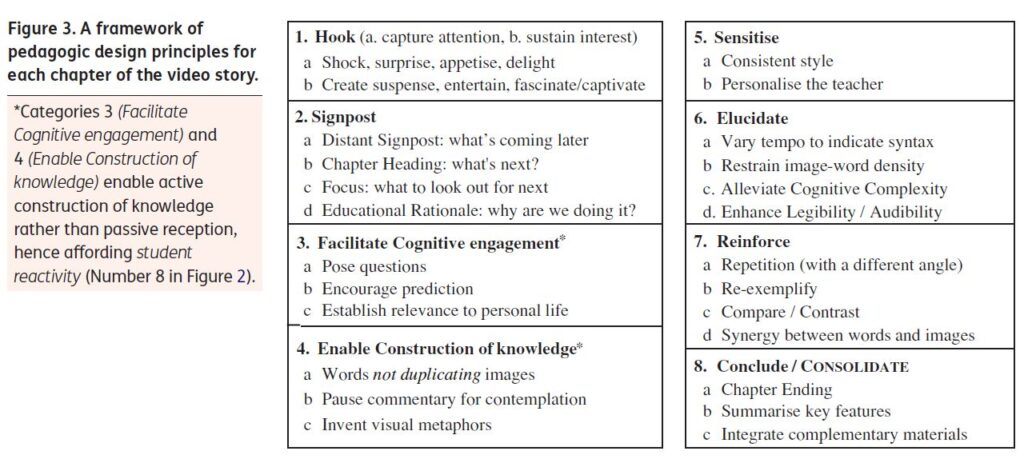
Whilst I have only read this framework after I’ve made my video I seem, either by good luck, judgment or unconscious replication of videos I’ve seen, to have hit most of these elements in my presentation.
Reference list
Edirisingha, P., Cane, C., Cane, R., Nikki, S. and University of Leicester (2009). Informal Mobile Podcasting And Learning Adaptations for Transition (IMAPAL4T). [online] www.advance-he.ac.uk. Available at: https://www.advance-he.ac.uk/knowledge-hub/informal-mobile-podcasting-and-learning-adaptations-transition-imapala4t [Accessed 27 Jun. 2023].
Gilly Salmon (2009). Podcasting for learning in universities. Maidenhead Open University Press, p.9.
Gimbar, K. (2011). How Do You Make Your Videos? Why? – FAQ – Katie Gimbar’s Flipped Classroom. [online] www.youtube.com. Available at: https://www.youtube.com/watch?v=Icn8kMoH28Y [Accessed 28 Jun. 2023].
Johnson, A. (2013). Excellent online teaching : effective strategies for a successful semester online. Aaron Johnson.
Oakley, B.A., Rogowsky, B. and Sejnowski, T.J. (2021). Uncommon sense teaching : practical insights in brain science to help students learn. New York: Tarcherperigee, An Imprint Of Penguin Random House Llc, p.216.
Peisley, A. (n.d.). Week 4: Podcast 1 – You can do it. Module EDU720 Developing Flexible Learning Environments.