This week we’ve been looking at the design of entirely online learning experiences. Taking what has been learned from the design and delivery of a Flipped Classroom and applying the concept of online learning to an entire course or module.
I have participated in a number of online only courses, including this one, and was interested to dig into how they differ, in terms of student engagement, from some of the MOOCs I’ve done which really are just a series of video lectures and optional online forums.
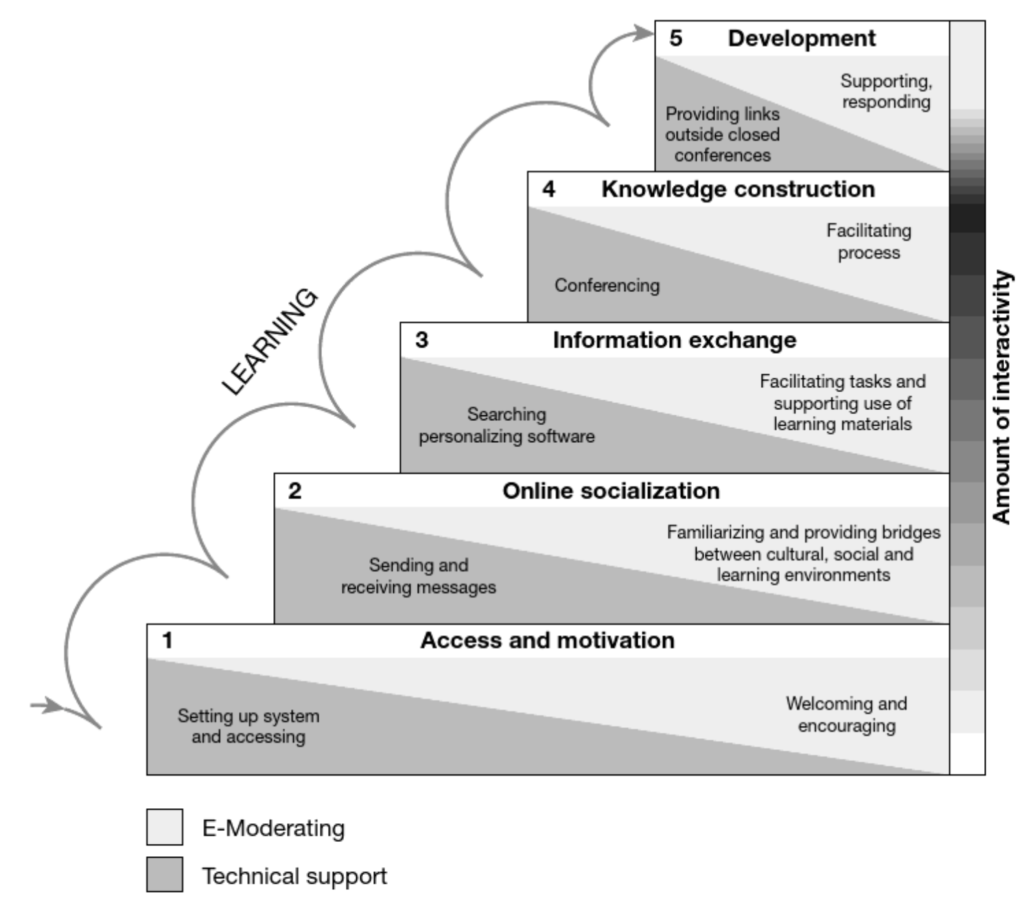
The most interesting reading this week was of Gilly Salmon’s ‘Five Stage’ model for building student engagement, participation and learning.
What is key about this model is that it aligns to the constructive principles of student-centric learning wherein…
Learners interact through team learning and by teaching each other.
(TEAL Centre Staff, 2010)
..so this model, therefore, seeks to build the necessary social network amongst the students whilst they learn so that they can then eventually learn from each other and see the value in learning in that manner. It acknowledges that the building of this network has to come through set exercises rather than to hope the network forms ‘naturally’ that may otherwise happen if they were congregating outside real-world classrooms together or meeting in the student union after a day at Uni.
To paraphrase from Salmon’s book:
Stage 1 – Is used to ensure the students find their own reasons and motivations to repeatedly access the learning community and technology. It introduces some interpersonal engagement but allows the students to find their way around for themselves.
Stage 2 – Is used for the students to start to establish the identities they will use online and find others within their cohort to interact with. This is the beginning of the building of a community of practice.
Stage 3 – Sees the students start to exchange information with each other. There should be a metal understanding of one another’s goals and the students should start to support each other in the achievement of those goals.
Blended courses put more responsibility for learning on the students, who must take the initiative to engage in many more online or independent learning activities.
(Stein and Graham, 2020, p.41)
Stage 4 – continues to develop that level of support and “more team-oriented and more complex knowledge construction begins.” (Gilly Salmon, 2013, p.17)
Stage 5 -should see students comfortable working in the learning environment and working with one another. The rhythm of the course should be clear and students will have figured out how to incorporate that into their broader lives and should now be functioning as a highly supportive student cohort.
This rhythm is really important for an online only course as it gives the students a clear sense of how to maintain progress on the course so that the cohort moves through the course at a relatively matched pace. The rhythm could be weekly or it could be set just so that the students start and end the course at the same point.
A blended course sets a rhythm through [synchronous] meetings but also allows for more individual student variation in the rhythm depending on the closeness of the [synchronous] sessions. Some blended course models frame the course with one opening and one concluding onsite meeting allowing the bulk of the activities to happen online. These course models sometimes called ‘multi-modal’ or ‘framed’, require that students be in sync by the end of the course, and perhaps for particular synchronous activities or milestones.
(Stein and Graham, 2020, p27)
The key thing about this model is that it is not about moving the students though it whilst they are learning and engaging in learning activities. It is that the learning activities should be designed so that they facilitate the movement of the students through the stages. So in stage 1 they carry out a predominantly solo activity but share it with their cohort through to stage 5 where they are working on joint projects and sharing knowledge freely.
Salmon refers the activities that the students carry out during these stages as ‘e-tivities’, a phrase that seems charming at first and then gets more annoying the further I get through the book.
In using these principles to draft a rough design of an HE module I found it difficult to quickly create a rhythm yet have different activities that led students through the stages. In my first draft I wrote it out as one stage per week but then the rhythm runs out over a 12 week module. To excuse for this design I suggested tat the design was ‘front loaded’, which is a valid design anyway and one I have experienced as a student.
Paul, a fellow student on the PGcHE said…
I like your idea of ‘frontloading’ students during the initial weeks which will set the scene for engagement and the latter part of the module further scaffolding student learning.
This is supported by the pedagogical scholarship of Gilly Salmon 2013 who states that ‘By Stage 4, many participants begin to recognise the great potential of online interaction and they start to take control of their own knowledge construction. Thinking is the key to making information useful (McDermott, 1999).
(Hughes, 2023)
..which I found encouraging. And Chelsea, also a peer, liked the initial design and suggested…
You have a clear structure to build from and clear pacing of activities. Moving forward, you could now consider the digital tools you may use and how they will support the students in their stage.
(Carter, 2023)
I think this is the next level to get into in the design, and digital tool selection should come at the same time as really looking at how the activities, or e-tivities, align to Salmon’s model.
Reference list
Carter, C. (2023). Week 8: Forum – Share Your Draft Design Ideas for an Online Course. [online] flex.falmouth.ac.uk. Available at: https://flex.falmouth.ac.uk/courses/1154/discussion_topics/28609?module_item_id=65411 [Accessed Jul. 2023].
Gilly Salmon (2013). E-tivities : the key to active online learning. London: Routledge, p.41.
Hughes, P. (2023). Week 8: Forum – Share Your Draft Design Ideas for an Online Course. [online] flex.falmouth.ac.uk. Available at: https://flex.falmouth.ac.uk/courses/1154/discussion_topics/28609?module_item_id=65411 [Accessed Jul. 2023].
Stein, J. and Graham, C.R. (2020). Essentials for Blended Learning, 2nd Edition. Routledge, p.41.
TEAL Centre Staff (2010). TEAL Centre Fact Sheet No. 6: Student Centred Learning. TEAL.