What have you learned this week about learning design and session planning?
This week has revolved around the writing of a lesson plan, a simple enough document and one that I assume would not get filled in with quite as much detail in real-life as this week’s assignment requires.
However digging into the detail is what is needed in order to really unpack the learning that sits behind much of the session plan’s “simple” boxes.
Filling the plan in correctly, usefully requires a nuanced understanding of the difference between the aims of the session as viewed from the teacher’s perspective and the learning outcomes of the session defined from the student’s perspective.
Just defining quality LOs is a science in itself with a need to use language that the students will understand, assessable verbs that can be tested, and qualified at six levels of competence as defined by Benjamin Bloom in 1956 as part of his Taxonomy of Learning Objectives.
Defining clear learning outcomes, essential the end of the process, is really the start of it all. This is similar to how I have defined solutions in my old job: if you have a clear idea of the problem and an agreed method for testing that the problem has gone, only then can you start to explore how you might go about solving the problem. As so it is with learning design.
The design process for learning, like many other design processes, are iterative though. The teaching and learning activities (TLAs), the Intended Learning Outcomes (ILOs), and the Assessment Tasks (ATs) are all intrinsically linked. Even if the aims stay the same and the ILO’s remain relatively constant how they are to be assessed is informed by how they might be taught, and how they are taught may be a matter of choice on the part of the teacher but will also be influenced by the nature of the environment, and the unique characteristics of the student cohort themselves.
How did you learn this?
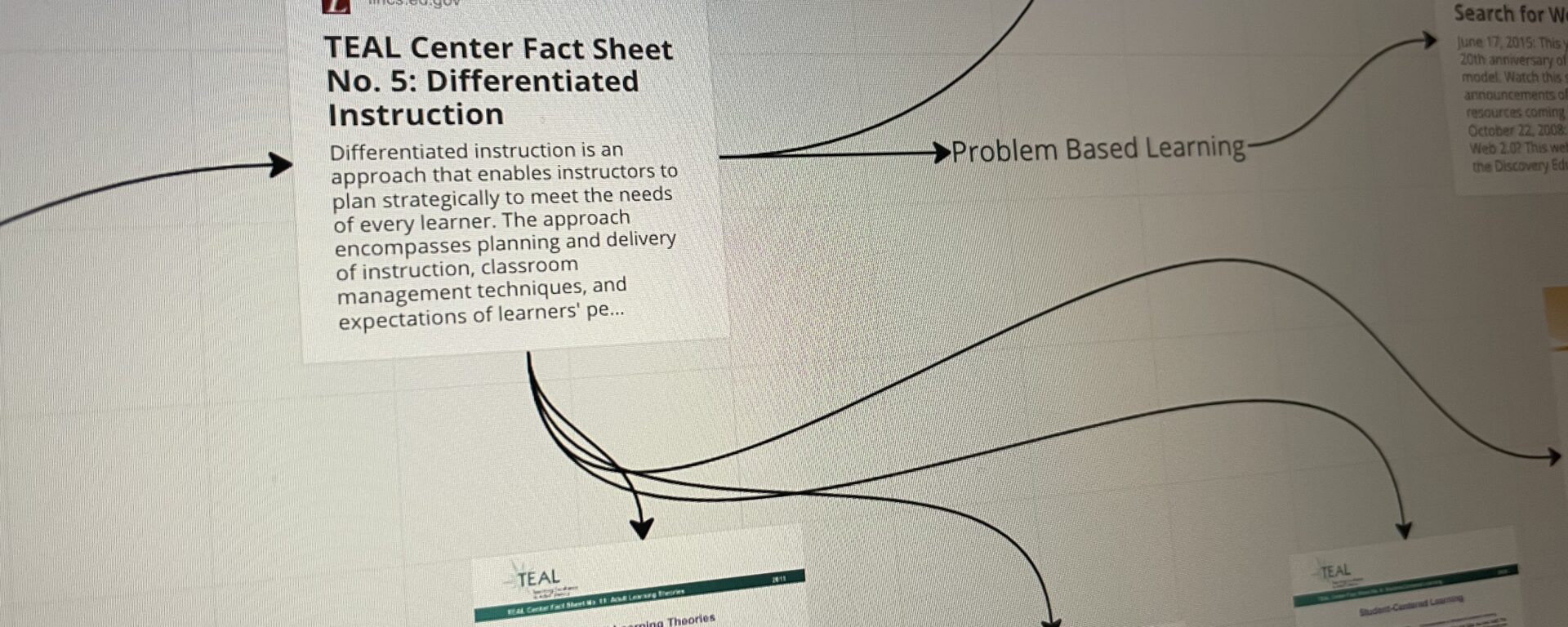
Much of this week’s learning has come from reading. Key texts being my ongoing cover-to-cover read of ‘Teaching for Quality Learning…” (Biggs, Tang, Kennedy) as well as some shorter PDFs an online articles such as the TEAL Center fact Sheets. The sheet on Differentiated Instruction was the one that led me down the most interesting research paths revealing interesting sources such as WebQuests and George Lucas’ Educational Foundation ‘Edutopia’. These latter sources being targeted at students before HE but that still have some interesting ways of looking at things and are interesting forums to explore.
Learning has also come from engagement and discussion with my fellow students on this course. Firstly via the structured forums but also through less structured, Teams chats that are more suited to getting to know one another, sharing thoughts and counselling each other through the study material and practical exercises.
What supported you?
As the whole student cohort is divided into smaller and smaller support groups the feeling of support seems to grow. This resonates with TEALs Fact Sheet 5 that discusses creating groups of students so that they can mentor one another through the delivery of an exercise through a technique known as Problem Based Learning.
The problem we have all been presented with is the design of a ‘micro-teach’ session where learning is introduced, imparted and assessed in a matter of 15 minutes.
What have you learned this week about the practice of supporting student learning in HE?
Supporting student learning has moved way beyond teacher-centric lectures where information is dryly imparted at students who are then tested on their ability to understand and retain that information some time later.
HE is now a much more student-centric environment where they do most of the work involved in learning. As a teacher planning is key so that the intent of the lesson is understood and the outcomes set. This then frees the teacher up to encourage the learning activities and make sure students of varying abilities and motivation can be encouraged by the teacher and their peers.
How has your understanding of this changed from doing this week’s topic and activities?
What has challenged you?
In writing my first draft of a learning plan I completed misunderstood the level of detail required in consideration of ‘Differentiated Instruction’.
Differentiated instruction is an approach that enables instructors to plan strategically to meet the needs of every learner. The approach encompasses planning and delivery of instruction, classroom management techniques, and expectations of learners’ performance that take into consideration the diversity and varied levels of readiness, interests, and learning profiles of learners.
(Tomlinson, 1999, 2001, 2003)
Further reading, and feedback from my peers will result in a more thorough dive into that part of my plan in the next draft.
What has surprised you?
I’ve been surprised by the breadth of theory on Lesson Design. Not that I thought it was simple, but I have enjoyed the reading this week and the way varying ideas are connecting and coming together in my head. By Bloom’s definition I think I am not quite reaching the ‘synthesis’ level but I can sense that will happen by the end of the course.
What actions can you identify from this that you could take to further develop your practice in the future?
To get there it is all about practice. The next step is delivering my micro-teach, the first piece of learning I’ll have deliberately and considerately designed. There is a lot of reading to do too, but in the spirit of student-centric learning it is really through doing that I am going to develop.