In a flipped classroom, lectures are no longer done onsite, but recorded, and put online where students can watch them in their own time, at their own pace, and as many times as needed. “Homework” is transformed into classwork, where problem solving activities are supported by direct interaction between the students and the teacher.
(Stein and Graham, 2014, p.35)
I first came across this concept of flipped learning over 10 years ago when binge-watching TED lectures. Seeing Sal Khan explain how he’d stumbled across the concept to teach his cousin’s math seems like an epiphany to me. “Of course, that’s how it should work!” I thought. For students to be lectured at in one shot and then be expected to recall the right information to do the practice element at home on their own seems really counter intuitive.
When observing students who watch lectures it has been noted that some watch all the way through once, then watch a second time to make notes; others pause the lecture to make notes on the first pass; and most go back to the lecture at the end of the term to revise for exams and assignments. The unflipped ‘lecture once’ model would seem to disadvantage most students.
In the flipped model the classroom becomes a collaborative space where the teacher moves from being the ‘sage on the stage’ broadcasting at the students and gearing their approach to the mid-range of students, and instead become ‘the guide on the side’, an adviser in a room where students don’t have to be doing the same thing at the same time and where they can ask the teacher for assistance as they practice the use of the knowledge individually or in groups.
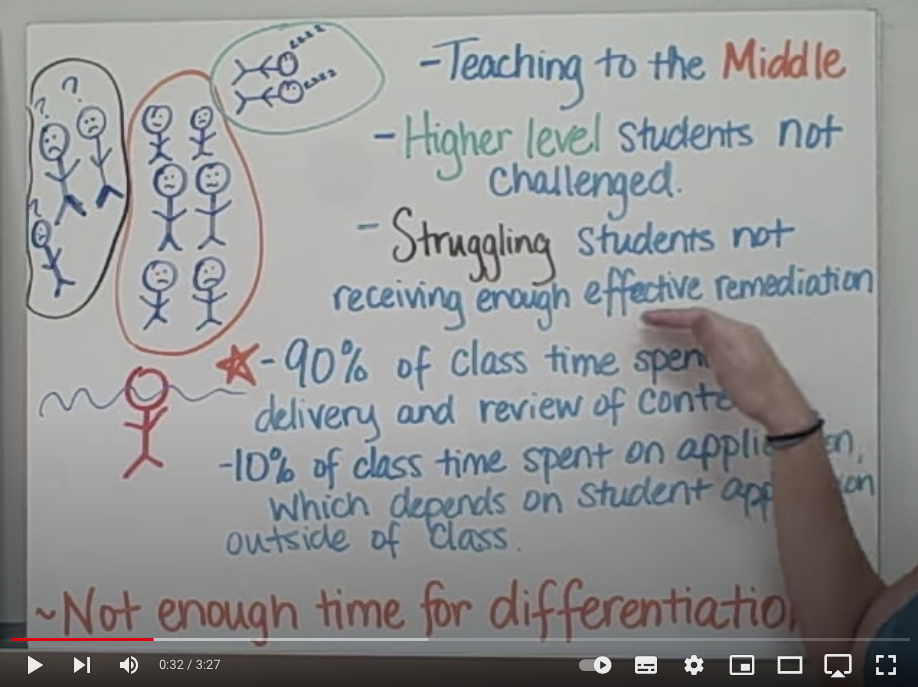
8th Grade maths tutor Katie Gimbar sums up the potential for the change nicely, in a series of videos posted to YouTube she describes how she moved her class from a model where she taught mainly to the middle range of students, whilst leaving advanced students bored, and struggling students, well struggling…
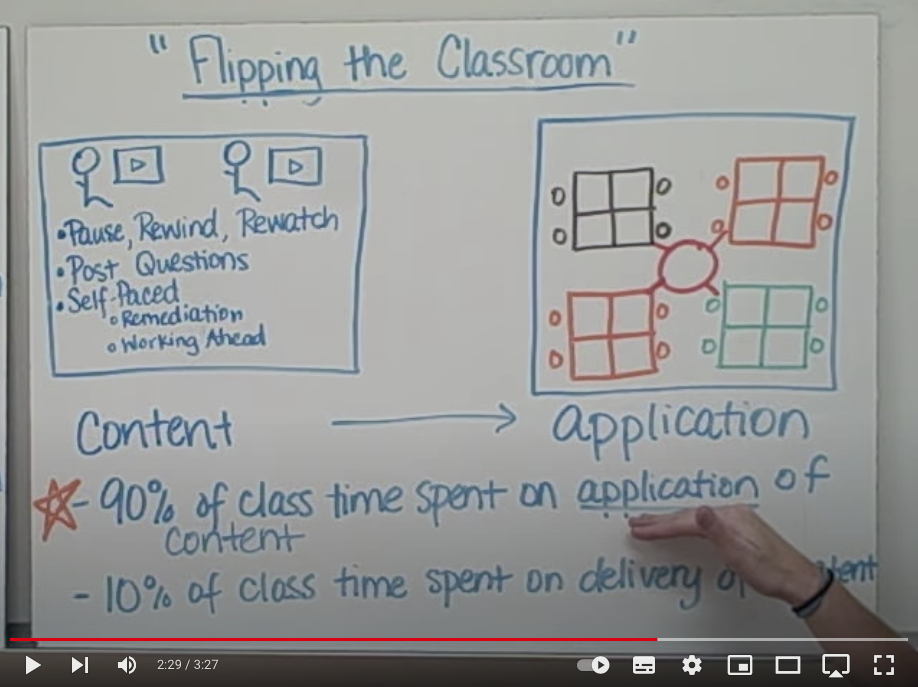
..to a model where the students consume the content in their own time and then her classroom is designed for her to support all ranges of students working on applying the content that they are currently trying to learn. Advanced students work ahead a little, struggling students are given more support, and the middle students even benefit from having the teacher there when carrying out what used to be “homework” activities.
Despite the seemingly obvious benefits of ‘flipping’ a classroom, it does put the onus on students to do the homework first. When discussing her flipped classroom implementations, my fellow student Cristina Iodice commented that…
The main issue I have encountered is that only the best students – “the Susan’s” (Biggs and Tang,2022) of the classroom who will have carried out the reading and engage in the lesson. Hence, I have had to give time in the lesson to read the article defeating the purpose of the flipped classroom. For the flipped classroom to be successful I believe it requires prior buy in from the students which is not easy.
(Iodice, 2023)
..and she was not alone in this experience. Implementing a flipped classroom won’t necessarily be an instant success for all students. it requires new ways of working to be understood, for new habits to be embedded into the student body and the teaching faculty.
Stein and Graham talk about courses having a rhythm and that in moving to blended courses we should also be conscious of the rhythm that needs to be built into the course.
Every course has a natural rhythm. Traditional courses have a rhythm marked by regular face-to-face, on-site meetings, weekly readings, independent practice, and mid-term and final assessment. The closeness of onsite sessions creates a rather tight, focussed rhythm that requires all learners to be in sync.
A blended course also sets a rhythm through onsite meetings, but also allows for more individual student variation in the rhythm, depending on the closeness of the onsite sessions.
(Stein and Graham, 2014, p.27)
In moving to a flipped classroom the design, and introduction should allow for students to adapt to the change of rhythm or to work to one they may not be familiar with. Literature and discussion with peers on this course seems to indicate that, over time, students understand the benefits of this way of teaching and that they take on the responsibility that is required of them to engage in the process actively.
Reference list
Iodice, C. (2023). Week 2: Forum – What are your experiences of ‘flipped classroom’ and other blended learning approaches? [online] Available at: https://flex.falmouth.ac.uk/courses/1154/discussion_topics/28619?module_item_id=65360.
McCammon, L. (2011). Why I Flipped My Classroom. [online] www.youtube.com. Available at: https://youtu.be/9aGuLuipTwg.
Stein, J. and Graham, C.R. (2014). Essentials for Blended Learning. Routledge, p.35.