When designing a Flipped Classroom (FC), or any form of blended learning it is important to consider, within the design, how the elements are integrated with one another and also to the wider course within which they sit.
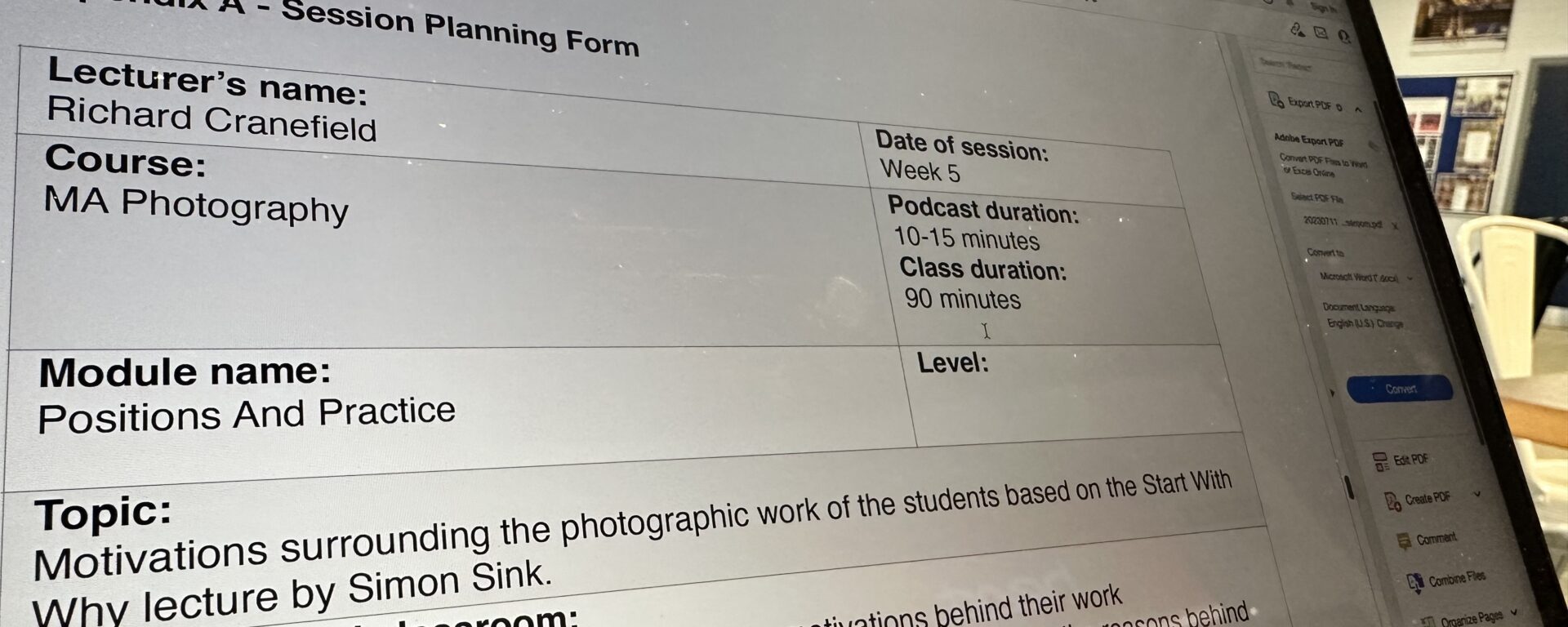
The learning activities in my FC are sequenced into three parts: a video where a concept is introduced and a reflective and research assignment set for the students; a short period for the students to research, reflect and prepare their findings; a small-group seminar with myself and 5-8 students to discuss what they have thought and found.
The video is made of three parts: I start by introducing a concept and clarifying which learning outcomes on the course it is relevant to. It then shows a video taken from YouTube by renowned author Simon Sinek elaborating on the idea, before I then explain further how that general concept relates to the act of Professionalism in Photography. I then invite the students to reflect on how the concept applies to their work and the work of other photographers they are coming across on the course and to bring that thinking to some webinars that are happening later this week.
I have deliberately created a video that uses my voice (not AI) and adopts a deliberately informal style
An informal tone helps to raise students’ emotional expectations for learning
(Gilly Salmon, 2009, p.9)
In Uncommon Sense Teaching Oakly et al suggest that…
Sharing your personality allows you to connect with an motivate your students – an essential first step in getting them to engage with the course materials”
(Oakley, Rogowsky and Sejnowski, 2021, p.216)
..which I think is key in this instance as the students do not know me as a core lecturer and an additional level of introduction or engagement is required.
The individual elements of the FC are well integrated together with a clear flow from one element to the next. When it comes to looking at how well this FC pilot is integrated into the rest of the course then, at present, it is sub-optimal. But this is mainly because this is an additional pilot and not part of the main course.
As I am only a guest lecturer on the course the students will only meet me for the first time on Tuesday of this week. There are then only 2-3 days between them being aware of the video and the face-to-face sessions. I’m concerned that many will not have had time to watch the video prior to attending the webinars so am viewing the daily viewing stats with interest.
The video and the f2f session are however tightly integrated into the learning outcomes of the module and the course and that link is made explicit in the narrative of the video. The insight will aid the students’ next assignment and become even more relevant in 18 months’ time when they start their FMP.
I have shared the design of my session and the video itself with a few colleagues to gauge opinion before delivering the FC elements.
Paul enjoyed the subconscious planting of reference books in the videos…
I think the way in which you used the various books as ‘props’ throughout your podcast and linked them to your overall lesson plan was also an almost subconscious delivery which I am sure will influence your learners to research those books without directing them to do so. This directly links with learner motivation and engagement as included within ‘Podcasting for learning in universities’ – Salmon 2008
(Hughes, 2023)
Whilst the books in the videos are not key to the student activity in this FC they are all highly relevant to the part of the video in which they appear and it’d be interesting if any students looked them up as further references.
Paul also commented on the lack of integration that my FC has within the wider course.
Whilst you cannot directly influence the integration of your flipped classroom approach you have recognised the importance of your learners ensuring they understand your teaching which will assist them as they move forwards with their studies. This is supported by ‘Trying new things is important because there is no perfect formula for a blended course. Even as you experiment with blended learning, make certain that your design choices are aimed at helping your students achieve the desired goals and outcomes’ (Stein and Graham 2020).
(Hughes, 2023)
Carlo also commented on the design and flagged the possible issue with simply leaving the face-to-face session wide open for discussion with no particular structure.
I’m wondering if you have planned a more structured series of activities besides the ‘broad discussion’, since in my experience when students are just asked to comment freely they might feel intimidated to speak and, most importantly, you might end up talking to the same (confident) people while others will be just silent.
(Convertini, 2023)
I wonder if I am being naive to assume I’ll be able to lead a useful and all-round discussion between all the students without first planning some sort of strategy to deal with challenges that will appear if students have not done the research work, or do not engage in the session.
Reference list
Convertini, C. (2023). Week 5: Forum – Integrating Activities in Your Flipped Classroom Designs. [online] flex.falmouth.ac.uk. Available at: https://flex.falmouth.ac.uk/courses/1154/discussion_topics/28613?module_item_id=65388.
Gilly Salmon (2009). Podcasting for learning in universities. Maidenhead Open University Press, p.55.
Hughes, P. (2023). Week 5: Forum – Integrating Activities in Your Flipped Classroom Designs. [online] flex.falmouth.ac.uk. Available at: https://flex.falmouth.ac.uk/courses/1154/discussion_topics/28613?module_item_id=65388.
Oakley, B.A., Rogowsky, B. and Sejnowski, T.J. (2021). Uncommon sense teaching : practical insights in brain science to help students learn. New York: Tarcherperigee, An Imprint Of Penguin Random House Llc, pp.212, 216.