We were asked this week to estimate the balance of types of learning that occur within the courses we currently teach. I don’t teach full time but have been working on an MA in Photography for the duration of this course, and its an MA i have been a student on myself.
The Cambridge Education Group has developed a pedagogic framework that has been applied to the design of both the MA i studied on and this PGcHE. The framework is based on key learning types defined by Diana Laurillard in her book ‘Teaching As A Design Science’. In it, she outlines types of learning and how the different types of conventional and digital technologies serve them…
| Learning Through | Conventional Technology | Digital Technology | |
| Acquisition | Learning through listening, reading and watching. | Reading books, papers; Listening to teacher presentations face-to-face, lectures; Watching demonstrations, master classes. | Reading multimedia, websites, digital documents and resources; Listening to podcasts, webcasts; Watching animations, videos. |
| Enquiry | Learners use existing learning resources for their own intellectual enquiry. | Using text-based study guides; Analyzing the ideas and information in a range of materials and resources; Using conventional methods to collect and analyze data; Comparing texts, searching and evaluating information and ideas. | Using online advice and guidance; Analyzing the ideas and information in a range of digital resources; Using digital tools to collect and analyze data; Comparing digital texts, using digital tools for searching and evaluating information and ideas. |
| Practice | Learners apply their understanding of the concepts to achieving a task goal. | Practicing exercises; doing practice-based projects, labs, field trips, face-to-face role-play activities. | Using models, simulations, microworlds, virtual labs and field trips, online role-play activities. |
| Production | Practising exercises; doing practice-based projects, labs, field trips, face-to-face role-play activities. | Producing and storing digital documents, representations of designs, performances, artefacts, animations, models, resources, slideshows, photos, videos, blogs, e-portfolios. | Producing and storing digital documents, representations of designs, performances, artifacts, animations, models, resources, slideshows, photos, videos, blogs, e-portfolios. |
| Discussion/Collaboration | Learning through discussion and collaboration: with or without the tutor present, small groups or large groups, structured or unstructured. | Tutorials, seminars, email discussions, discussion groups, online discussion forums, class discussions, blog comments. Small group project, discussing others’ outputs, building joint output. | Online tutorials, seminars, email discussions, discussion groups, discussion forums, web-conferencing tools, synchronous and asynchronous. Small group project, using online forums, wikis, chat rooms, etc. for discussing others’ outputs, building a joint digital output. |
The Cambridge model structures these into a 5 step sequence of which, it is argued, a certain balance should be struck between Learning Through Experience (Enquiry, Practive and Production) 70%; Learning Through Others (Discussion) 20%; and Learning through didactic methods (Acquisition) 10%
This split can be adapted depending on the nature of the subject and could be viewed in the context of an entire course but it certainly emphasises the need for there to be fewer lectures AT students and more activities where they learn from experience. This model fits well with the constructivist principles described by Biggs et al…
All forms of constructivism emphasise that learners construct knowledge with their own activities, and that they interpret concepts and principles in terms of the schemata that they have already developed through prior experience.
(Biggs, Tang and Kennedy, 2022, p.18)
…and is a reminder that although teachers should allow students to learn from one another that learning should occur mainly through activities that require the production of something rather than simply encouraging knowledge sharing through discussion. Phil Race cites Matheson and Sutcliffe (2018) who stated that “group work can be used to reduce the pressure in individual students, allowing them to hear other perspectives, providing the opportunity to challenge and have their own ideas challenged leading to the development of collective solutions.” (Matheson and Sutcliffe, 2018)
Race himself admits he finds the most useful parts of MOOCs are the ensuing discussions that occur after the lecture or reading has been delivered. (Race, 2014, p.215)
The Cambridge sequence works well when applied to a week of learning activities – at least that is how it has been applied on the part-time MA and PGcHE that I have studeid on, and directly follows the constructivist principle of hooking into what a student knows and then building upon that. The basic framework looks like this…
| Step | Name | Description |
| 1 | Introduction ‘Hook & Discussion’ | The Introduction section helps students activate prior knowledge / experience they may already have on the topic. This is also an opportunity to relate the weekly topic to the students’ personal experience or current practice. |
| 2 | Guided Practice | This section represents the weekly ‘lecture’ in which learners acquire factual or procedural knowledge related to the topic.The provision of intrinsic feedback in the form of self-directed questions or activities is encouraged in this step. |
| 3 | Challenge Activity | In this section learners apply their knowledge by enquiring, practising and receiving extrinsic feedback on specific pieces of work they produce. |
| 4 | Reflection | This section provides space for students to reflect on what they have learned during the week. How has their understanding of the concepts studied changed? How may it change their practice? |
| 5 | Webinar (synchronous live activity) | Webinars provide an opportunity to discuss specific points that needed further discussion during the week. Webinars can also be used to discuss module assignments and projects. |
An example of this framework’s application, and time split according to Learning Type/Descriptor, is as follows…
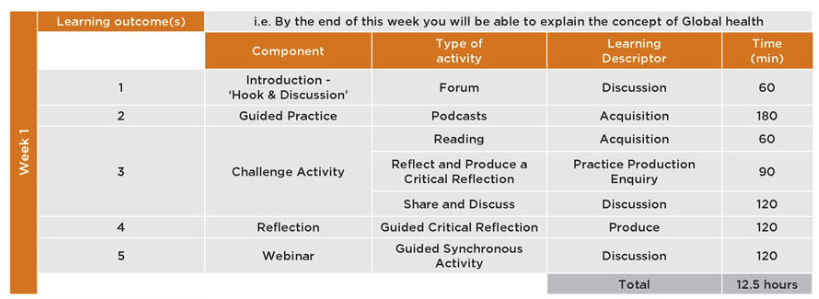
In this example, the ‘activities’ have been selected from a range of possible activities suggested by CEG in a series of cards that are split between the acquisition of learning through low-order cognitive skills (factual or procedural knowledge) and high-order cognitive skills such as dialogue, collaboration, discussion and reflection.
In trying to apply this framework to a week-long version of my flipped classroom I found it relatively easy to come up with the initial activities, but the balance of time spent on each did not align to the 70/20/10 split that is used as a guideline. To rebalance this I re-wrote the challenge activity so that it would require students to invest more time in enquiry and production, and I reduced the length of the seminar at the end of the week so that less time was taken up with discussion.
My peer on the PGcHE course, Nicola, commented that the 70:20:10 ratio should not be used prescriptive (Futers, 2023), which I agree with but Simon appreciated my honesty in admitting that i’d redrafted the design in order to come closer to the 70:20:10 ratio (Tovee, 2023) and i think the learning would be improved having done so.
Reference list
Biggs, J., Tang, C. and Kennedy, G. (2022). Teaching for Quality Learning at University 5e. Open University Press, p.18.
Futers, N. (2023). Week 10: Forum – Share Your CEG Pedagogic Framework Form. [online] flex.falmouth.ac.uk. Available at: https://flex.falmouth.ac.uk/courses/1154/discussion_topics/28605?module_item_id=65429 [Accessed 11 Aug. 2023].
Laurillard, D. (2012). Teaching as a design science : building pedagogical patterns for learning and technology. New York, Ny: Routledge.
Race, P. (2014). Lecturer’s toolkit. Routledge, p.215.
Tovee, S. (2023). Week 10: Forum – Share Your CEG Pedagogic Framework Form. [online] flex.falmouth.ac.uk. Available at: https://flex.falmouth.ac.uk/courses/1154/discussion_topics/28605?module_item_id=65429 [Accessed 11 Aug. 2023].